Enhancing Visual Communication with the Smile Icon from Success Collection
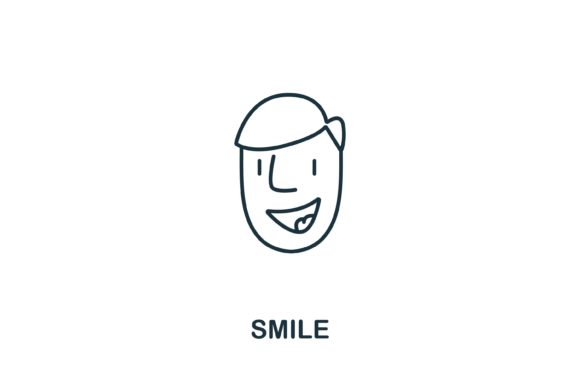
In the crowded landscape of digital design, clarity often triumphs over complexity. Designers and content creators constantly search for visual shorthand that communicates positive sentiment instantly without requiring cognitive load from the viewer. This is where the Smile Icon from Success Collection proves its enduring value. As a simple line element smile symbol, it serves as a foundational building block for templates, web design, and infographics that require a touch of optimism or confirmation. Unlike overly detailed illustrations that can clash with modern minimalist aesthetics, this vector graphic offers a clean, versatile solution that integrates seamlessly into professional workflows.
The Power of Minimalist Line Art in Modern Interfaces
The shift toward flat design and minimalism has made line icons a staple in user interface (UI) and user experience (UX) design. The Smile icon from success collection exemplifies this trend by stripping away unnecessary gradients and shadows to focus purely on form. This simplicity is not merely an aesthetic choice; it is a functional necessity. When designing responsive websites or mobile applications, assets must remain legible at various sizes. A complex, shaded smiley face might look charming at 500 pixels wide but becomes an unrecognizable blob when scaled down to a 24-pixel notification badge.
Line elements maintain their integrity regardless of scale. The consistent stroke weight ensures that the symbol remains crisp on high-density retina displays and standard screens alike. For web designers, this means faster load times and sharper rendering. Because the Smile Icon from Success Collection relies on geometric precision rather than rasterized pixels, it supports the fluid nature of modern CSS frameworks. Whether you are placing it inside a button, using it as a list marker, or featuring it as a hero graphic, the line art style guarantees visual consistency across your entire project ecosystem.
Vector Versatility: EPS and JPG Formats Explained
One of the primary advantages of acquiring this specific asset is the inclusion of both EPS and JPG files. Understanding when to use each format is crucial for maintaining design quality. The EPS (Encapsulated PostScript) file is your master source. It is a true vector format, meaning it uses mathematical equations to define lines and curves rather than a grid of colored pixels. This makes the Smile Icon from Success Collection infinitely scalable. You could print this icon on a business card or blow it up for a billboard, and the edges would remain perfectly sharp.
Furthermore, the EPS format allows for deep customization. If your brand guidelines dictate a specific shade of blue or a thicker stroke weight, you can open the EPS file in Adobe Illustrator, CorelDRAW, or Affinity Designer and modify the anchor points directly. This "easy to edit" characteristic transforms a generic stock asset into a bespoke brand element. Conversely, the included JPG file serves immediate, non-destructive needs. It is perfect for quick mockups, presentation slides, or social media posts where vector editing software is unavailable or unnecessary. Having both formats in one package streamlines the handoff process between designers, developers, and marketing teams who may have different technical capabilities.
Psychological Impact in Infographics and Data Visualization
Data visualization is often perceived as cold or clinical, yet the most effective infographics tell a human story. Incorporating the Smile icon from success collection into charts, graphs, and statistical layouts introduces an emotional anchor. In behavioral psychology, even abstract representations of facial expressions can trigger mirror neurons, subtly influencing how information is received. When presenting customer satisfaction scores, net promoter ratings, or successful project milestones, this symbol acts as a visual reinforcement of the positive data point.
However, context matters significantly. The utility of this icon extends beyond mere decoration. In instructional design and e-learning modules, it functions as a feedback mechanism. A green checkmark confirms correctness, but a smile adds a layer of encouragement and empathy that rigid symbols lack. For template creators, including this simple line element smile symbol provides end-users with a ready-made tool for softening corporate messaging. It bridges the gap between analytical rigor and human connection, making dense information more digestible and engaging for diverse audiences.
Integration into Brand Identity Systems
Logos and brand marks frequently utilize simplified geometry to ensure memorability. While the Smile Icon from Success Collection is designed as a standalone element, its clean construction makes it an excellent candidate for logo modification or secondary branding. Companies in the wellness, education, childcare, and service industries often seek imagery that conveys approachability without appearing juvenile. The refined line work of this vector graphic strikes that delicate balance. It suggests professionalism through its precision while retaining the universal warmth associated with smiling.
When adopting this symbol for brand purposes, consider its relationship to negative space. Because it is a line element, the interior of the smile is transparent. This allows background colors, textures, or photography to show through, creating dynamic interactions within the layout. Designers can place the Smile icon from success collection over vibrant gradients for a contemporary tech feel or against muted earth tones for an organic, sustainable vibe. This adaptability reduces the need to create multiple versions of an icon for different seasonal campaigns or sub-brands, saving valuable production time and maintaining visual coherence.
Practical Considerations for Template Designers
For professionals creating sellable templates on platforms like Creative Market or Envato Elements, asset licensing and editability are paramount. The promise that this resource is "easy to edit and use" addresses a major pain point for template buyers. Users expect to drag, drop, and recolor assets without wrestling with grouped layers or expanded strokes that break upon modification. The Smile Icon from Success Collection should ideally feature organized layers and named paths, ensuring that even novice users can customize it confidently.
Additionally, semantic relevance in template design cannot be overlooked. When tagging or categorizing templates that utilize this icon, accuracy improves discoverability. Terms like "success," "feedback," "emotion," and "line art" help connect the asset with users searching for specific solutions. Beyond metadata, the actual implementation within the template should demonstrate best practices. Showing the simple line element smile symbol in multiple contexts—such as a testimonial section, a pricing tier highlight, and a footer contact area—educates the buyer on its potential applications. This educational aspect increases the perceived value of the template and showcases the icon’s flexibility.
Optimizing Web Performance with Vector Graphics
Site speed is a critical ranking factor and user experience metric. Traditional image formats contribute significantly to page bloat, whereas vector graphics offer a lightweight alternative. When implementing the Smile Icon from Success Collection on a website, converting the EPS source to SVG (Scalable Vector Graphics) code is often the optimal strategy. SVGs are text-based XML files that can be compressed to mere kilobytes. They render instantly and can even be animated via CSS or JavaScript to create micro-interactions, such as a smile that appears when a form is successfully submitted.
This performance benefit extends to accessibility as well. Unlike raster images that rely solely on alt text for screen readers, inline SVGs can include title and description tags directly within the code structure. This ensures that the semantic meaning of the Smile icon from success collection is conveyed to all users, regardless of ability. Furthermore, because vectors are resolution-independent, they eliminate the need for serving multiple image sizes for different device breakpoints. A single SVG definition handles everything from smartwatches to 4K monitors, simplifying the development workflow and reducing server requests. By prioritizing vector-native assets, designers future-proof their projects against evolving display technologies while maintaining the highest standards of visual fidelity.