Killer Whale Vector Graphics: Integrating Marine Iconography into Professional Design Systems
The intersection of natural history and digital communication creates a unique demand for specialized visual assets. Among the most requested motifs in the wild animals collection is the Killer Whale, a symbol that carries significant weight in environmental, educational, and corporate contexts. When designers and content creators seek to represent this apex predator, they are rarely looking for photorealistic complexity. Instead, the industry standard has shifted toward the simple line Killer Whale icon. This stylistic choice is not merely an aesthetic preference but a functional necessity for modern templates, web design, and infographics. The transition from biological subject to vector graphic requires a deep understanding of both the animal’s defining characteristics and the technical requirements of scalable logo design.
Functional Applications Across Digital and Print Media
The utility of a well-crafted Killer Whale icon extends far beyond decorative embellishment. In professional environments, this graphic serves as a semantic anchor, instantly communicating themes of oceanography, marine conservation, travel, and ecological balance. Understanding where and how to deploy these assets is critical for maximizing their impact.
Web Design and User Interface Integration
In the realm of user experience (UX) and user interface (UI) design, clarity is paramount. A complex illustration of an orca can become illegible when scaled down to navigation menu sizes or favicon dimensions. The simple line art approach solves this resolution challenge. By utilizing clean strokes and negative space, the Killer Whale icon remains recognizable at 16 pixels just as effectively as it does on a hero banner. Web designers utilize these vectors to create cohesive visual languages for marine biology institutes, eco-tourism operators, and sustainable seafood certifications. The minimalist aesthetic aligns with contemporary flat design trends, ensuring that the site feels modern rather than dated.
Educational Infographics and Data Visualization
Researchers and educators face the challenge of translating dense scientific data into accessible formats. When presenting information regarding migration patterns, pod social structures, or trophic cascades, the visual hierarchy must guide the viewer’s eye without causing cognitive overload. A stylized Killer Whale symbol acts as an effective bullet point or section header within infographics. Unlike photographic images, which carry inherent texture and color noise, line icons provide a neutral visual container for information. This allows the data itself to take precedence while maintaining thematic consistency throughout the presentation. For academic posters and textbook layouts, the ability to recolor these vectors ensures they match specific institutional branding guidelines or accessibility contrast ratios.
Corporate Branding and Merchandise
For business owners and marketers, the Killer Whale represents power, intelligence, and community. These attributes are highly transferable to corporate identity systems. However, trademarking and reproduction require versatile source files. A vector-based logo derived from the wild animals collection allows for infinite scalability without quality loss. Whether applied to a massive conference backdrop or embroidered onto a polo shirt, the crisp lines of the icon maintain integrity. This adaptability reduces production costs and streamlines the workflow for marketing teams who need to generate assets rapidly across multiple touchpoints.
Anatomical Accuracy in Minimalist Representation
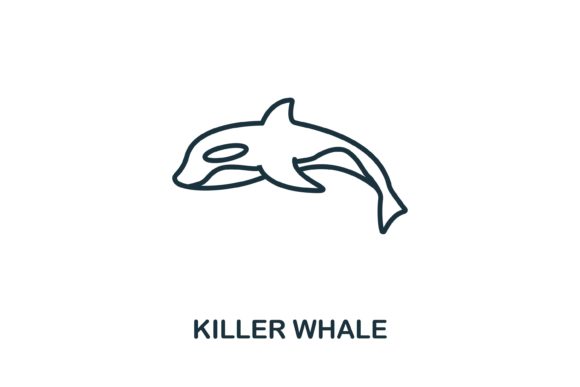
Creating or selecting a high-quality Killer Whale icon requires more than artistic flair; it demands biological literacy. Even in simplified line art, certain anatomical features must be preserved to distinguish the orca from other cetaceans like dolphins or pilot whales. Professionals evaluating these assets should look for specific markers that ensure the icon reads correctly to knowledgeable audiences.
- Dorsal Fin Proportions: The dorsal fin is the most diagnostic feature of the Killer Whale. Male orcas possess a tall, triangular dorsal fin that can reach six feet in height, while females have a shorter, curved fin. Accurate icons often default to the male silhouette for its graphic boldness, but female representations are equally valid and sometimes preferred for organizations focusing on maternal pod dynamics.
- Patch Placement: The white eye patch and saddle patch are non-negotiable identifiers. In line art, these are typically represented through negative space or broken lines. Incorrect placement of the saddle patch behind the dorsal fin can make the icon resemble a generic dolphin, undermining the specific symbolism of the Killer Whale.
- Body Mass and Shape: Orcas are robust animals with a distinctively stocky build compared to the streamlined form of oceanic dolphins. Effective vector graphics capture this mass through confident, sweeping curves rather than jagged or overly slender lines. The pectoral flippers should be broad and rounded, reflecting the animal's actual morphology.
- Behavioral Posture: Static profiles are common, but dynamic poses such as breaching, spy-hopping, or tail-slapping add narrative value. The chosen posture should align with the intended message; a breaching whale suggests energy and excitement, while a swimming profile implies steady progress and stability.
Technical Specifications and File Format Advantages
The practical value of any digital asset is defined by its technical flexibility. When acquiring a Killer Whale icon from a wild animals collection, the inclusion of both EPS and JPG files addresses distinct stages of the creative workflow. Understanding the specific advantages of each format ensures efficient implementation.
The Primacy of EPS Vectors
The Encapsulated PostScript (EPS) file is the industry standard for professional design work. Unlike raster images composed of fixed pixels, EPS files rely on mathematical paths. This distinction offers several critical benefits for users working with Killer Whale imagery:
- Infinite Scalability: Designers can resize the icon from a business card dimension to a billboard scale without experiencing pixelation or blurring. This is essential for responsive web design where assets must adapt to various viewport widths.
- Editability: Every curve and node in an EPS file can be manipulated using software like Adobe Illustrator or Affinity Designer. Users can adjust the stroke weight, modify the curvature of the dorsal fin, or combine the icon with typography to create custom lockups. This level of control transforms a stock asset into a bespoke brand element.
- Color Independence: Vector files allow for instant recoloring. A black Killer Whale icon can be converted to white for dark mode interfaces, or adjusted to specific Pantone spot colors for print production, all within seconds. This eliminates the need to maintain multiple versions of the same graphic.
- Clean Output: EPS files typically contain transparent backgrounds by default, removing the tedious step of masking out white boxes. This transparency is vital for layering the icon over textured backgrounds, photographs, or colored UI elements.
The Role of JPG Rasters
While EPS is superior for production, the JPG file serves as an essential preview and quick-use format. Not all stakeholders have access to vector editing software. Providing a high-resolution JPG ensures that clients, project managers, and non-design team members can view, approve, and insert the Killer Whale icon into documents, presentations, and mood boards without technical barriers. Furthermore, certain web platforms and legacy systems still require raster inputs. Having a pre-rendered JPG optimized for screen display saves time during the prototyping phase. The dual-format delivery model bridges the gap between professional design capabilities and general organizational accessibility.
Strategic Considerations for Visual Communication
Selecting the right Killer Whale icon involves more than technical compatibility; it requires cultural and contextual awareness. The orca is a species with complex public perception, ranging from awe-inspiring wilderness ambassador to controversial captive performer. Design choices implicitly signal where an organization stands within this spectrum.
Minimalist line art tends to neutralize some of the emotional baggage associated with photorealistic imagery. By abstracting the animal into a symbol, the focus shifts toward the concept of the marine ecosystem rather than individual animal welfare debates. This abstraction makes the simple line Killer Whale icon particularly suitable for broad-spectrum applications where the goal is to evoke nature generally rather than comment on specific ethical issues. However, users must remain vigilant about accuracy. Stylization should never cross into caricature. An icon that misrepresents the species' anatomy can inadvertently signal a lack of expertise or respect for the subject matter, damaging credibility with scientific and conservation-minded audiences.
Furthermore, accessibility standards must inform the implementation of these graphics. When using Killer Whale icons in web design, proper alternative text descriptions are mandatory. Screen readers cannot interpret vector paths; they rely on semantic markup. Describing the image as "stylized killer whale icon representing marine conservation initiatives" provides context that pure alt text like "whale" lacks. Additionally, color contrast ratios apply to line art just as they do to text. Ensuring that the stroke color maintains sufficient contrast against the background is not only a legal requirement in many jurisdictions but also a best practice for inclusive design.
The integration of wildlife iconography into professional workflows represents a maturation of visual communication. It acknowledges that symbols drawn from the natural world carry inherent meaning that synthetic geometry cannot replicate. By prioritizing technical versatility through EPS vectors, maintaining biological integrity in design, and applying strategic foresight in deployment, professionals can leverage the Killer Whale icon as a powerful tool for connection and communication. The availability of easy-to-edit assets democratizes high-quality design, allowing everyone from solo researchers to multinational corporations to tell compelling stories about our oceans with precision and style.