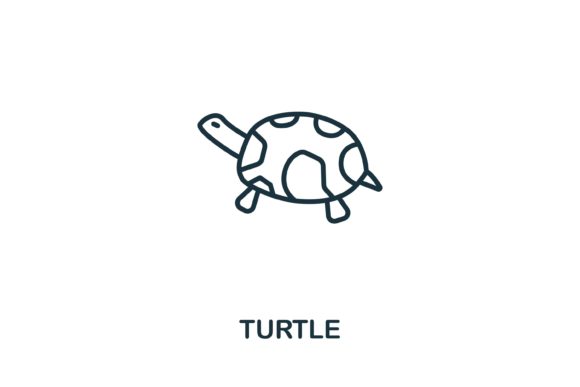
Turtle Icon from Wild Animals Collection
Visual communication often hinges on the ability to convey complex ideas through simple, recognizable symbols. When designing for environmental themes, educational content, or nature-focused branding, finding the right balance between detail and simplicity is crucial. The Turtle Icon from Wild Animals Collection serves as a versatile graphic asset that bridges this gap effectively. Unlike hyper-realistic illustrations that can clutter a layout, this simple line turtle icon offers a clean aesthetic suitable for modern templates, web design, and infographics. It provides designers and content creators with a professional symbol that is immediately identifiable yet unobtrusive enough to function within larger visual systems.
Defining Characteristics of the Vector Asset
The primary strength of this turtle icon lies in its minimalist line art style. In an era where flat design and scalable vector graphics dominate digital interfaces, heavy shading and complex gradients often feel outdated or fail to render correctly across different screen sizes. This icon utilizes clean strokes and open negative space, ensuring legibility whether it is displayed as a 16-pixel favicon or blown up for a trade show banner. The "simple line" approach also implies a sense of elegance and modernity, moving away from cartoonish depictions often associated with animal graphics.
Technically, the inclusion of both EPS and JPG files addresses the full spectrum of design workflows. The EPS (Encapsulated PostScript) file is the industry standard for vector graphics. It allows you to scale the image infinitely without losing resolution, change stroke colors to match specific brand guidelines, or adjust line weights to harmonize with other icons in your set. The JPG file acts as a convenient preview or a quick-use asset for non-designers who need to drop the image into a Word document or PowerPoint presentation without opening specialized software. This dual-format delivery ensures the asset remains accessible to professional designers in Adobe Illustrator while remaining usable for marketers working in Canva or Microsoft Office.
Practical Applications Across Industries
The utility of the Turtle Icon from Wild Animals Collection extends far beyond generic decoration. Its specific visual language makes it particularly valuable in several distinct sectors:
- Environmental and Conservation Marketing: For NGOs and sustainable brands, the turtle is a universal symbol of longevity, marine conservation, and slow-living philosophy. Using a refined line icon rather than a photograph allows organizations to maintain a cohesive brand identity across annual reports, donation pages, and merchandise without relying on stock photography that may not align with their specific color palette.
- Educational Materials and E-Learning: Educators creating worksheets, slide decks, or interactive modules benefit from consistent iconography. A simple turtle icon can denote biology sections, patience-related lessons, or oceanography topics. Because the design is uncluttered, it reduces cognitive load for students, allowing the graphic to support the text rather than compete with it.
- User Interface and App Design: Mobile applications focused on travel, wellness, or outdoor activities require intuitive navigation. This icon works exceptionally well as a tab bar element, a category marker for eco-tours, or a badge indicating pet-friendly or family-paced amenities. Its vector nature ensures crisp rendering on high-DPI mobile displays.
- Infographics and Data Visualization: When presenting data about wildlife populations, climate change impacts, or biodiversity, consistency is key. Mixing photographic turtles with line-art trees creates visual dissonance. This icon integrates seamlessly into infographic templates, serving as a bullet point, a timeline marker, or a legend key that maintains stylistic unity throughout the visualization.
Enhancing Brand Identity and User Experience
Beyond mere aesthetics, selecting the right icon influences how users perceive a brand's professionalism and attention to detail. A poorly sourced or pixelated turtle graphic can undermine trust, especially in commercial or educational contexts. By utilizing a dedicated vector asset like the Turtle Icon from Wild Animals Collection, creators signal a commitment to quality. The editable nature of the EPS file means the icon can evolve with the brand; if a company rebrands from green to blue, the icon can be updated instantly without needing to redraw it or hunt for a new replacement.
From a user experience perspective, familiar symbols reduce friction. Users process icons faster than text labels. However, the symbol must be distinct enough to avoid confusion with similar shapes. The anatomical accuracy retained in this simple line design—despite its minimalism—ensures that viewers recognize it as a turtle rather than a generic blob or rock. This clarity is essential for accessibility, ensuring that neurodivergent users or those with visual processing differences can interpret the content accurately.
Considerations for Implementation and Editing
To maximize the value of this asset, users should approach implementation with intentionality. While the JPG is ready for immediate use, investing time in the EPS file yields better long-term results. If you are incorporating this turtle into a larger icon set, verify that the stroke width matches your existing library. You may need to expand the appearance or adjust the stroke profile in your vector editing software to ensure visual weight consistency. Additionally, consider the context of the background; line icons generally perform best on solid or low-contrast backgrounds. If placing the icon over a busy photograph, adding a subtle backing shape or increasing the stroke weight can preserve readability.
Licensing and usage rights are also critical factors for professionals. Always confirm the specific license terms associated with the Wild Animals Collection before deploying the icon in commercial products, templates for resale, or large-scale advertising. Understanding these parameters protects your business and respects the creator's intellectual property. Furthermore, when using the icon in digital formats, export SVG versions from the EPS source whenever possible. SVGs offer smaller file sizes and better CSS control than embedded raster images, contributing to faster page load times and improved SEO performance.
Why Simplicity Wins in Modern Design
The trend toward simplified iconography is not just a stylistic preference; it is a functional necessity. As screens diversify and attention spans shorten, graphics must communicate instantly. The Turtle Icon from Wild Animals Collection exemplifies this principle by stripping away non-essential details to focus on the essence of the subject. For freelancers and agencies managing multiple client projects, having a reliable library of such high-quality, editable assets significantly accelerates production time. Instead of drawing a custom turtle for every environmental campaign, designers can leverage this pre-made vector as a foundation, customizing it to fit specific needs while maintaining a baseline of professional quality.
Ultimately, this asset represents more than just a picture of an animal; it is a tool for effective communication. Whether you are building a website for a marine sanctuary, designing a children’s book about patience, or creating a corporate sustainability report, the right icon anchors your message. By combining technical versatility with timeless design principles, the Turtle Icon from Wild Animals Collection provides a practical solution for creators who demand both efficiency and aesthetic integrity in their work. It transforms a simple biological reference into a powerful component of visual storytelling, proving that even the most basic elements can drive significant engagement when executed with precision.